The Cultivating Life Movement Method
I'm a paragraph. Click here to add your own text and edit me. It's easy.
Remembering the way humans were designed to move
For almost all of human history, movement wasn’t “exercise.”
It was life.
Adventure.
Exploration.
Play.
Humans walked through forests and mountains.
Collected fruit from trees.
Gathered herbs, roots, nuts, and plants.
Carried water and children.
Climbed, balanced, squatted, reached, twisted, swam, explored, and adapted.
Near coastlines, humans likely spent long periods swimming, gathering sea vegetables, navigating rocks and tides, and moving across uneven shorelines.
The human body evolved through movement variety — not through chairs, cars, and screens.
And even now… your body still remembers.
WHY MOVEMENT MATTERS
Your body was not designed for one position all day.
Your shoulders evolved for:
-
climbing
-
reaching
-
carrying
-
balancing
-
swimming
-
moving freely through nature
Your hips evolved to:
-
walk long distances
-
squat close to the earth
-
climb hills and rocks
-
move across uneven ground
-
transition smoothly between movements
Your feet evolved for forests, rivers, sand, coastlines, mountains, and earth — not only flat floors.
For millions of years, movement shaped:
-
posture
-
balance
-
coordination
-
circulation
-
breathing
-
resilience
-
nervous system health
-
emotional wellbeing
-
Modern research increasingly supports what many traditional movement systems already understood:
the body thrives on varied, natural movement.
WHY THIS MATTERS TODAY
Many modern aches and imbalances are not simply because we are “getting older.”
Often, we are simply under-moving in the ways humans evolved to move.
Too little:
-
walking
-
squatting
-
twisting
-
balancing
-
reaching
-
crawling
-
carrying
-
floor sitting
-
climbing
-
moving across varied terrain
The result?
Tight hips.
Stiff backs.
Weak glutes.
Rounded shoulders.
Poor posture.
Reduced balance.
Shallow breathing.
Not because the body is broken.
Because it is underused.
At Cultivating Life, yoga is not approached simply as stretching or performance.
It becomes a way of reconnecting with the natural movement patterns humans evolved with for hundreds of thousands of years.
THE 7 HUMAN MOVEMENT PATTERNS
1. PUSH
Rising from the earth
Humans evolved pushing themselves up from the ground, climbing upward, swimming through water, and moving through the natural world.
This movement pattern helps build:
-
strength
-
confidence
-
posture
-
shoulder stability
-
resilience through the whole upper body
Our practices may include:
-
playful plank variations
-
flowing ground transitions
-
slow strength-building movement
-
balancing practices
-
controlled bodyweight movement
One surprisingly powerful marker of healthy ageing?
Being able to sit on the floor… and stand back up again.
2. PULL
Reaching, climbing & opening the upper body
Humans evolved climbing trees, pulling fruit from branches, carrying objects, and moving through landscapes using the upper body.
Modern life often leaves the front of the body overworked and the back of the body sleepy.
This can contribute to:
-
rounded shoulders
-
neck tension
-
tight chests
-
tired upper backs
Our practices may include:
-
playful hanging movements
-
shoulder-opening flows
-
climbing-inspired movement
-
gentle strength practices
-
flowing arm patterns
-
movements that help the body feel open and spacious again
Your shoulders evolved for forests and movement… not just screens.
3. SQUAT
Returning to the ground
For most of human history, the floor was part of daily life.
Humans squatted to:
-
rest
-
prepare food
-
gather plants
-
wash
-
socialise
-
move close to the earth
Our practices may include:
-
deep resting squats
-
low flowing transitions
-
hip-opening movement
-
ankle-opening practices
-
grounded floor movement
-
playful movement close to the earth
Benefits include:
-
freer hips
-
healthier knees
-
stronger legs
-
better balance
-
easier everyday movement
Your hips are not old.
They may simply be under-travelled.
4. HINGE
Learning to bend naturally again
Humans evolved bending to gather food, lift objects, carry water, climb rocks, and move close to the earth.
Many people today bend mostly through the lower back instead of the hips.
This can make movement feel stiff and heavy.
Our practices help restore:
-
freer hips
-
stronger legs
-
easier bending
-
healthier posture
-
smoother everyday movement
Practices may include:
-
flowing forward bends
-
grounded standing movement
-
balancing transitions
-
playful folding patterns
-
strong but relaxed movement through the legs and hips
The muscles along the back of the body help us walk, climb, lift, and stand tall through life.
5. LUNGE
Human movement in motion
Walking is essentially controlled falling.
Humans evolved moving across:
-
forests
-
hills
-
rivers
-
mountains
-
uneven ground
-
coastlines
This movement pattern supports:
-
balance
-
coordination
-
walking mechanics
-
hip strength
-
confidence moving through space
Our practices may include:
-
flowing standing sequences
-
stepping patterns
-
balancing movement
-
climbing-inspired transitions
-
strong grounded leg movement
Every step you take is a tiny act of balance.
6. ROTATE
Humans evolved in spirals
Humans naturally twist and spiral while:
-
walking
-
swimming
-
climbing
-
reaching
-
carrying
-
exploring the world around them
Modern life often keeps us moving in straight lines.
The result?
Many people feel stiff through the spine, ribs, shoulders, and hips.
Our practices may include:
-
flowing twists
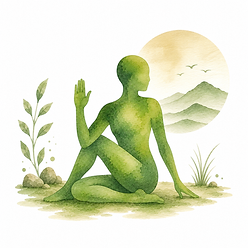
-
spiral movement
-
wave-like transitions
-
gentle coiling and uncoiling
-
breath-led movement
-
flowing practices inspired by Tai Chi
A healthy spine is less like a brick… and more like a river.
7. CARRY + GAIT
Humans are extraordinary endurance movers
Humans are remarkable walking animals.
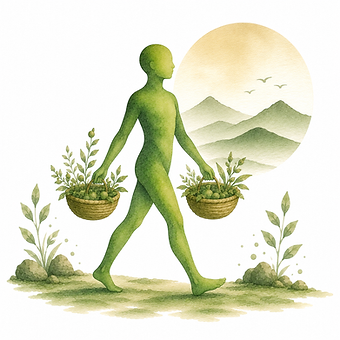
For hundreds of thousands of years, humans walked through landscapes carrying:
-
children
-
water
-
gathered plants
-
food
-
simple tools
-
woven materials and carried bundles
This shaped:
-
posture
-
endurance
-
breathing
-
coordination
-
balance
-
cardiovascular health
Our practices may include:
-
mindful walking
-
balancing movement
-
mountain walks
-
barefoot awareness
-
slow flowing movement
-
meditative movement practices
-
gentle carrying patterns
-
flowing walking practices inspired by Tai Chi
Walking may be one of the most underrated longevity practices on Earth.
THE DEEPER IDEA
The body is not separate parts.
It is an integrated movement system shaped by nature, terrain, gravity, breath, and experience.
At Cultivating Life, yoga becomes more than flexibility.
It becomes a way of reconnecting with the movement intelligence humans evolved with for hundreds of thousands of years.
Not performance.
Not punishment.
Not chasing perfection.
But returning to movement that feels:
-
natural
-
strong
-
calm
-
capable
-
adaptable
-
alive
FINAL THOUGHT
We were never designed to sit still all day.
We were designed to move through life.
And perhaps… part of wellbeing is simply remembering how.